“The truth is provisional.”

Joan Didion questioned the idea of objective journalism, writes Hilton Als in his Foreword for Didion’s last collection of essays, Let Me Tell You What I Mean. Admit that you have filters, and that “who you are at the time you wrote this” determines what you see.  … Read More

“I did not wish to take a cabin passage, but rather to go before the mast and on the deck of the world. . .”

Henry David Thoreau continues, “for there I could best see the moonlight amid the mountains. I do not wish to go below now.” This beautiful image of Thoreau watching the stars from the deck of a boat comes right after he says that he decided to leave … Read More

“Any radical change in poetic form is likely to be the symptom of some very much deeper change in society and in the individual.”

What a crank T. S. Eliot must have been! He is the champion of contradiction. Consider this: his difficult and complex poem “The Love Song of J. Alfred Prufrock” revolutionized poetry, and many consider it to be a prime example of social criticism. And yet, he … Read More

“When we no longer know which way to go, we have begun our real journey.”

When I was deciding whether to come back to teach one more year, I realized that the part that I like best is not giving information, it’s getting questions – especially questions that I have never explored before with students. This week, my last first week of … Read More

“Americans, it turns out, smile more than any other society on earth.”

Susan Cain, whose book Quiet launched her career as the Patron Saint of Introverts ten years ago, has written a new book that validates English teachers, artists, and everyone who is drawn to sad stories. Her argument – that “sorrow and longing make us whole” – is … Read More

“She gave me a piece of gingerbread which was so generously spread with salt butter that the richness was too much for me and I couldn’t eat it.”

Molly Weier, who was born in 1910 in Glasgow, had her own definition of what it meant to be rich. To her, it was having real butter instead of margarine and spreading it generously. This is how someone in her neighborhood lived, and it impressed her … Read More

“I became a fine singer . . .in later years I was to be of great help to my husband with his song writing.”

As a fan of the Scottish poet Robert Burns, I was unaware of the role that Burns’ wife played with the development of his songs until I toured the home that he lived in at the time of his death in 1796. Jean, who by all accounts … Read More

“The man o’ independent mind / He looks an’ laughs at a’ that.”

Picture this: in the 1700s, a poet from Scotland united his fellow countrymen by showing them how to respond to the rich and powerful. He recommended laughter. Meet Robert Burns – known as the “ploughman poet” – who grew up doing backbreaking field work during the day … Read More

“We did not have clothes suitable for church.”

The New York Times uses “spare” and “charming” to describe this memoir about growing up on a Wisconsin farm during the Great Depression. I would add “remarkable” to this list. When she was six years old, the children at her school contributed their pennies to buy a … Read More

“I stand here coiled in orbits, head to foot, because this tilted world is where I live.”

The great poet Henry Taylor must have been in a cranky mood when he compiled this collection of 100 poems that span his 50-year career. Taylor chose not to follow the convention of inviting a respected peer to write an introduction; he selected a cover that makes … Read More

“There is a notion that creative people are absent-minded, reckless, heedless of social customs and obligations.”

The poet Mary Oliver continues: “It is, hopefully, true.” She argues that interruptions and schedules and errands are the enemies of creative work. I’ve been thinking a lot about the level of concentration that writing require. I’m working with writers this summer who, in many cases, haven’t … Read More

“Writing is similar to psychotherapy in that emotional disclosure is part of the healing process.”

Some of the people who attend my memoir workshops come to write their family history, others want to write memorable stories, and yet others want to discover meaningful answers to their questions about “life.” This book, written by a psychotherapist, is for this third group of … Read More

“Life is not a series of gig lamps symmetrically arranged; life is a luminous halo . . .”

Virginia Woolf argues that life is not comprised of an orderly series of events, but rather, life is complex and spiritual in nature. Therefore, when writing about life, novelists should “. . . convey this varying, unknown and uncircumscribed spirit, whatever aberration or complexity it may display … Read More

“There was this air, this light, a day of thorough and forgetful happiness . . .”

How many Pulitzer-Prize winning poets write about happiness? I can think of only one, Henry Taylor, who is considered by some critics to be “deliberately, determinedly unfashionable.” Why? Perhaps it is because his “technically well-ordered style and leisurely reflections of life” (which are comparable to Robert Frost’s … Read More

“People writing about imaginary events were less depressed than people writing about actual trauma.”

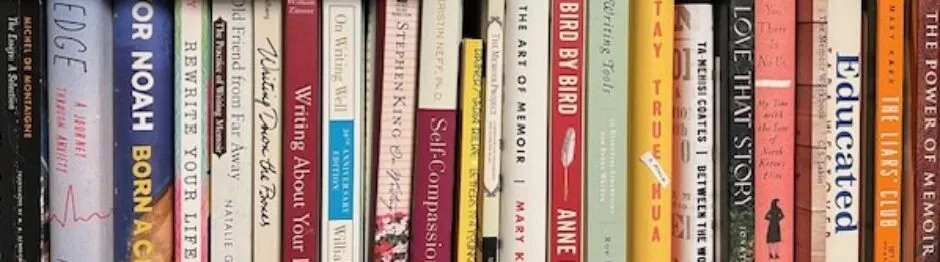
In Rewrite Your Life: Discover Your Truth Through the Healing Power of Fiction, Jessica Lourey cites academic research that found that people who write fiction can experience more physical health benefits than people who write autobiography.  In my college classes, I’ve found that asking students to … Read More